Sector Guide
Solar Farm Security
The complete guide to protecting utility-scale solar estates - perimeter fencing, intrusion detection, surveillance integration and solar-powered protection, from a UK perimeter security manufacturer.
Why solar farms are targeted
A utility-scale solar farm concentrates exactly what organised thieves want: kilometres of copper cabling, high-value inverters and panels, on a remote, unmanned site with a long boundary and - too often - nothing but a stock fence between the assets and the road. Cable theft does not just cost the replacement copper: it takes generation offline, triggers insurance claims and can put feed-in commitments at risk. Repeat victimisation is common, because a site that proved easy once attracts a second visit.
The security challenge is shaped by the environment: wide rural perimeters, limited mains power at the boundary, patchy connectivity, planning constraints on what can be built - and, increasingly, an obligation to keep the land recoverable when the installation reaches end of life. Effective solar farm security works with those constraints rather than fighting them.
The layered approach that works
No single measure secures a solar estate. The sites that stop losing cable combine a physical boundary, detection, verification and response - each layer sized to the site's risk and budget:
Perimeter fencing and barriers
The boundary sets the tone. Options range from full security fencing to lightweight agricultural or deer fencing where planning or land-use rules demand a low-impact barrier - with detection technology carrying the security load. An electrified fence adds active deterrence where the risk justifies it.
Fence-mounted intrusion sensors
Flexiguard™ vibration-detection sensor cable turns any fence - security or agricultural - into a monitored detection line. Climbing, cutting or lifting the fence raises a zoned alarm, so operators know exactly which section of a multi-kilometre boundary is under attack. Tuning rejects wind and wildlife to keep false alarms down.
Open-ground and gate detection
Microguard™ microwave sensors and Omni Guard Radar cover gates, access tracks and open approaches where there is no fence to sense - detecting a person crossing the protected zone and cueing cameras onto them automatically.
Electrified deterrent where it counts
Electro-Fence™ pulsed electric fencing - a safe, non-lethal deterrent compliant with BS 1722-17 and IEC 60335-2-76 - protects substations, inverter compounds and other high-value zones inside the estate, where a determined intruder must be actively repelled, not just detected.
Monitoring, CCTV and response
Every sensor reports into a single monitoring platform - Multisys® on-site or wirelessly to a remote CCTV control room. Alarms trigger automatic camera verification of the affected zone, so responders roll to confirmed intrusions instead of false callouts.
Access control and site management
Controlled gates, tracked keyholding and clear zones for maintenance contractors close the everyday gaps - most daytime losses walk in through an open gate, not over the fence.
Security that runs on the same sunlight
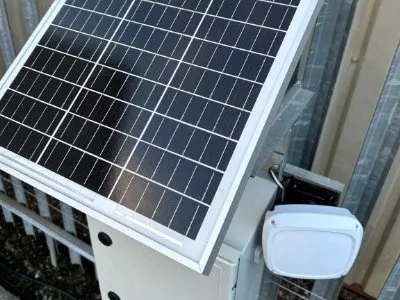
The distinguishing problem of solar farm security is power at the perimeter - the boundary can be a kilometre from the nearest usable supply. APS engineers around this: Flexiguard™ detection and Electro-Fence™ energisers are available in solar-powered, battery-backed configurations (including the EF BAT-SOL variant), with wireless alarm transmission back to the control point. No trenching, no cabling runs, no mains dependency - a security system as off-grid as the site it protects.
That also changes the sustainability equation. Unlike towers and temporary infrastructure that must be serviced and fuelled, a solar-powered detection perimeter has minimal ground disturbance at installation, low running energy, and full land recoverability when the estate is repurposed.
Proven In The Field
Case study: a UK solar farm, secured without a security fence
Delivered with Technicom UK: a fully wireless, solar-powered Flexiguard™ deployment on a deer-fence boundary - chosen so the land stays recoverable for other uses in around 25 years. Zoned detection pinpoints the attacked section; alarms transmit wirelessly to the CCTV control room, and cameras verify the zone automatically.
Solar-powered, off-grid operation
Pinpoint section-level detection
Land-reuse design horizon
Standards, insurance and planning
Insurers increasingly set perimeter requirements for renewable assets, and a monitored detection system materially changes the risk they are pricing. On the compliance side, the references that matter for a solar estate are BS 1722-17:2017 (electric security fences) and BS EN IEC 60335-2-76 (energiser safety) where electrified fencing is used, Secured by Design principles for the overall scheme, and NPSA guidance on perimeter intrusion detection for critical-infrastructure-grade sites. APS is an ISO 9001:2015 certified UK manufacturer; our safety and conformity documentation is available for planning and insurance submissions.
Site Assessment
Securing a solar farm? Start with the boundary.
Tell us the site size, boundary type and what you are protecting against, and an APS engineer will recommend a layered system - and tell you honestly where you do not need to spend. We design and manufacture in the UK and deliver through installation partners nationwide.
Related reading: the complete guide to non-lethal electric fencing.
Request a solar farm assessment
No obligation - boundary, detection and budget questions welcome.