Knowledge · Perimeter Security
Non-Lethal Electric Fence (NLEF): the complete guide
What a non-lethal electric fence is, how it works, the standards that keep it safe, and where it protects people and property - written by the manufacturer behind Electro-Fence™ and Pulstar™ energisers.
What is a non-lethal electric fence?
A non-lethal electric fence - NLEF for short, sometimes called a pulsed electric fence, monitored pulse fence or stun fence - is a perimeter security barrier whose wires carry short, regulated high-voltage pulses. Touch it and you receive a shock that is sharp, painful and completely memorable - but engineered to be safe. The pulse is too brief and carries too little energy to cause lasting harm.
That combination makes an NLEF the strongest legal deterrent a site can put on its boundary: it actively repels intruders rather than passively slowing them down, and unlike razor wire it does so without maiming anyone. Every wire is also a sensor - cut it, climb it, or short it to ground and the energiser raises an instant, zone-specific alarm.
Non-lethal electric fences deliver the three functions specifiers ask of any perimeter system - deter, detect and delay - in a single layer of hardware.
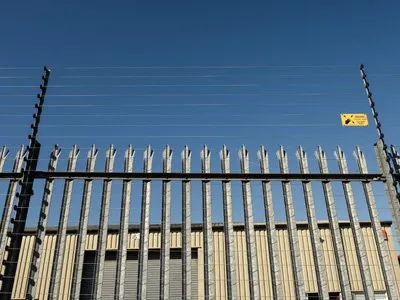
Electro-Fence™ - an APS non-lethal electric security fence, manufactured in the UK.
Not the same as an agricultural fence
Searches for electric fencing often mix two very different products. Agricultural energisers manage livestock and wildlife - keeping cattle in a pasture or deer out of a boundary - and are designed around animal control. A security NLEF is a different class of system: higher wire counts in a dense array, monitored zones, alarm outputs into a control room, tamper detection and compliance with security-fence standards. This guide covers the security application; if you need stock fencing, an agricultural supplier is the right place to start.
How a non-lethal electric fence works
Four components do the work:
The energiser
The heart of the system (also called a fence charger or controller). An APS Pulstar™ energiser converts mains, battery or solar power into brief high-voltage pulses - typically one per second - and continuously monitors the electrical health of every zone it drives.
The wire array
Multiple strands of tensioned, electrified wire mounted on the fence line - either as a complete freestanding barrier or an addition to an existing fence. More wires mean a denser barrier and finer detection.
Posts and insulators
Purpose-made posts carry the array; insulators isolate each live wire so the pulse energy goes where it should. Quality insulation is what keeps false alarms down in rain, salt air and pollution.
Monitoring and alarms
The energiser measures voltage and current on every pulse. A cut wire, a climbing intruder shorting strands together, or a deliberate ground-out each produce a distinct electrical signature - and an immediate alarm to the control system, per zone.
Why the shock is painful but safe
The safety of a non-lethal electric fence is not a marketing claim - it is engineered to internationally agreed physical limits. Under IEC/BS EN 60335-2-76, the safety standard for electric fence energisers, a compliant security energiser must keep every pulse within strict bounds - measured against a 500-ohm load representing a human body:
Maximum pulse repetition rate - at most one pulse per second
Maximum impulse duration - the shock is over in milliseconds
Maximum energy per impulse for energy-limited energisers
The result is a humane deterrent: enough current to guarantee an intruder lets go and leaves, nowhere near enough to injure. The gap between pulses also means anyone who contacts the fence can always release it. This is the fundamental difference between an NLEF and the lethal electrified barriers used on a small number of maximum-security state facilities - and it is why non-lethal electric fencing is legal for commercial and government use across the UK, the US and most of the world when installed to standard.
The standards that govern NLEF
Specifiers and procurement teams should look for these documents by name:
BS EN IEC 60335-2-76:2021
The safety standard for electric fence energizers - including security fences. Defines the pulse-energy, duration and repetition limits above. The benchmark cited in UK and international specifications; adopted internationally from IEC 60335-2-76.
BS 1722-17:2017
The British Standard for electric security fences: design, installation and maintenance. The document UK consultants write into perimeter specifications for systems like Electro-Fence™.
ASTM F3297-19
The US Standard Practice for Corrections Application of Non-Lethal Electric Security Fences (ASTM Committee F33 on Detention and Correctional Facilities). Sets the corrections-specific requirements: IEC-limited pulse output, minimum eight-hour battery backup, and alarms on circuit-open, wire-to-wire and wire-to-ground conditions.
UL 69 - what it does not cover
A common misconception: UL 69 covers electric fence controllers for animal-control fencing only, and explicitly excludes electrified security fences. A vendor citing UL 69 for a security NLEF is citing the wrong standard - ASTM F3297 and IEC 60335-2-76 are the applicable references.
Where non-lethal electric fences are used
NLEF systems protect sites where the cost of a breach is highest and a passive barrier is not enough:
- Correctional facilities. The largest NLEF application in the United States: a monitored pulse fence between the inner and outer fence lines deters and detects escape attempts, replacing or reducing continuous tower staffing. See our dedicated page on prison perimeter systems and retrofits below.
- Critical infrastructure. Power stations, substations, water treatment works and communications sites - where metal theft and sabotage threaten essential services.
- Commercial and industrial sites. Distribution centres, depots, scrap and recycling yards and any perimeter suffering repeat intrusion and theft.
- Solar farms and remote estates. Paired with solar-powered energisers and detection for boundaries far from mains power.
NLEF in corrections - and replacing an ageing system
Many US correctional facilities installed monitored pulse fences a decade or more ago. As those systems age, facilities face a choice: an expensive like-for-like rebuild with the original vendor, or a retrofit. APS specialises in the retrofit path - replacing the energisers, monitoring and control software while reusing the existing wire array, field enclosures and communications network. In one published state Department of Corrections project, the complete turnkey retrofit, including operator training, was finished in five working days - and the client went on to install identical APS systems at two further prisons.
FAQ
Non-lethal electric fence questions, answered.
What is a non-lethal electric fence (NLEF)?
A non-lethal electric fence, also called a pulsed electric fence, monitored pulse fence or stun fence, is a perimeter security barrier whose wires carry short, regulated high-voltage pulses. Touching it gives a sharp, memorable shock that is too brief and carries too little energy to cause lasting harm, and every wire doubles as a sensor that raises a zone-specific alarm when cut, climbed or shorted.
Is a non-lethal electric fence legal?
Yes. Non-lethal electric fencing is legal for commercial and government use across the UK, the US and most of the world when installed to standard. The energiser must keep every pulse within the limits of IEC and BS EN 60335-2-76, and UK installations follow BS 1722-17:2017.
How is an NLEF different from a lethal electrified barrier?
A compliant NLEF energiser limits each pulse to at most one per second, no more than 10 milliseconds long and no more than 5 joules of energy, measured against a 500 ohm load representing a human body. That guarantees an intruder lets go and leaves without being injured. Lethal electrified barriers, used on a small number of maximum-security state facilities, have no such limits and are a different class of system.
Which standards apply to non-lethal electric security fences?
BS EN IEC 60335-2-76:2021 for energiser safety, BS 1722-17:2017 for the design, installation and maintenance of electric security fences in the UK, and ASTM F3297-19 for corrections applications in the United States. UL 69 covers animal-control fence controllers only and explicitly excludes electrified security fences.
Can an ageing prison NLEF be retrofitted rather than replaced?
Yes. APS specialises in retrofitting the energisers, monitoring and control software while reusing the existing wire array, field enclosures and communications network. In one published state Department of Corrections project the complete turnkey retrofit, including operator training, was finished in five working days.
Talk To The Manufacturer
Specifying a non-lethal electric fence?
APS designs and manufactures NLEF systems in the UK and has supplied them worldwide for four decades - including correctional facilities across the United States. Tell us about your site and an engineer will come back with a straight answer on fit, compliance and budget.
Prefer the paperwork first? Download the Electro-Fence datasheet from the product page.
Ask an NLEF engineer
No obligation - sizing, standards and retrofit questions welcome.