Sector Guide
Airport Perimeter Security
Protecting the airside boundary: what makes airport perimeters different, what recent breaches teach, how a layered perimeter is built and which standards actually apply, from the manufacturer that secured the 17.4 km perimeter wall of Hyderabad International Airport.
What makes an airport perimeter different
Airports concentrate more risk per metre of fence than almost any other site. The perimeter is long, often tens of kilometres, it runs through open ground beside active runways, and the consequences of a breach are measured in grounded aircraft, diverted flights and, in the worst cases, lives. Passenger screening gets the attention. The fence line and the airside access points are where most incursions actually happen.
- Length and openness. Boundaries of 10 to 20 km around flat, open ground, with long sightlines and little cover for intruders or for sensors.
- Constant legitimate activity. Vehicles, ground crews, aircraft noise and vibration, wildlife and weather all look like intrusion to a badly tuned system. Nuisance alarms are the enemy of a credible response.
- Access points. Vehicle gates, service roads and contractor entrances are the weak points most breaches exploit, not the fence itself.
- Regulation. Airports must meet ICAO Annex 17 and their national programme, such as the UK National Aviation Security Programme, EU Regulation 300/2008 or TSA 49 CFR Part 1542. They also answer to insurers, and need detection that is auditable and does not interfere with airside operations.
What recent breaches teach
Each of these incidents shows a different way an airport perimeter fails.
Chicago O’Hare, 2025
Two breaches in ten days: a delivery driver entering a restricted area, then a security officer waving vehicles through a checkpoint without ID checks. Lesson: vehicle access points undermine the whole perimeter if they are not detected and controlled. Source: CBS News
San Jose, 2014
A teenager climbed the fence and hid in a wheel well, surviving a flight to Hawaii. Lesson: a fence without detection is a delay, not a defence. Source: RAND
Geneva and Ibiza, 2023
Climate activists walked onto the airfield and grounded flights. Lesson: motivated people without tools or weapons can still cause millions in disruption.
Milan Orio al Serio, 2024
A man passed several layers of security, ran onto the apron and died after being drawn into an aircraft engine. Lesson: perimeter security protects intruders from themselves as well as protecting the airport.
Gatwick, 2018
Drone sightings closed the runway on and off for the best part of two days, affecting around 140,000 passengers and 1,000 flights. Lesson: the perimeter is not only a line on the ground. Source: Wikipedia
How a layered airport perimeter is built
No single technology covers an airport. The sites that work combine four layers, each doing a job the others cannot.
Deter and delay at the line
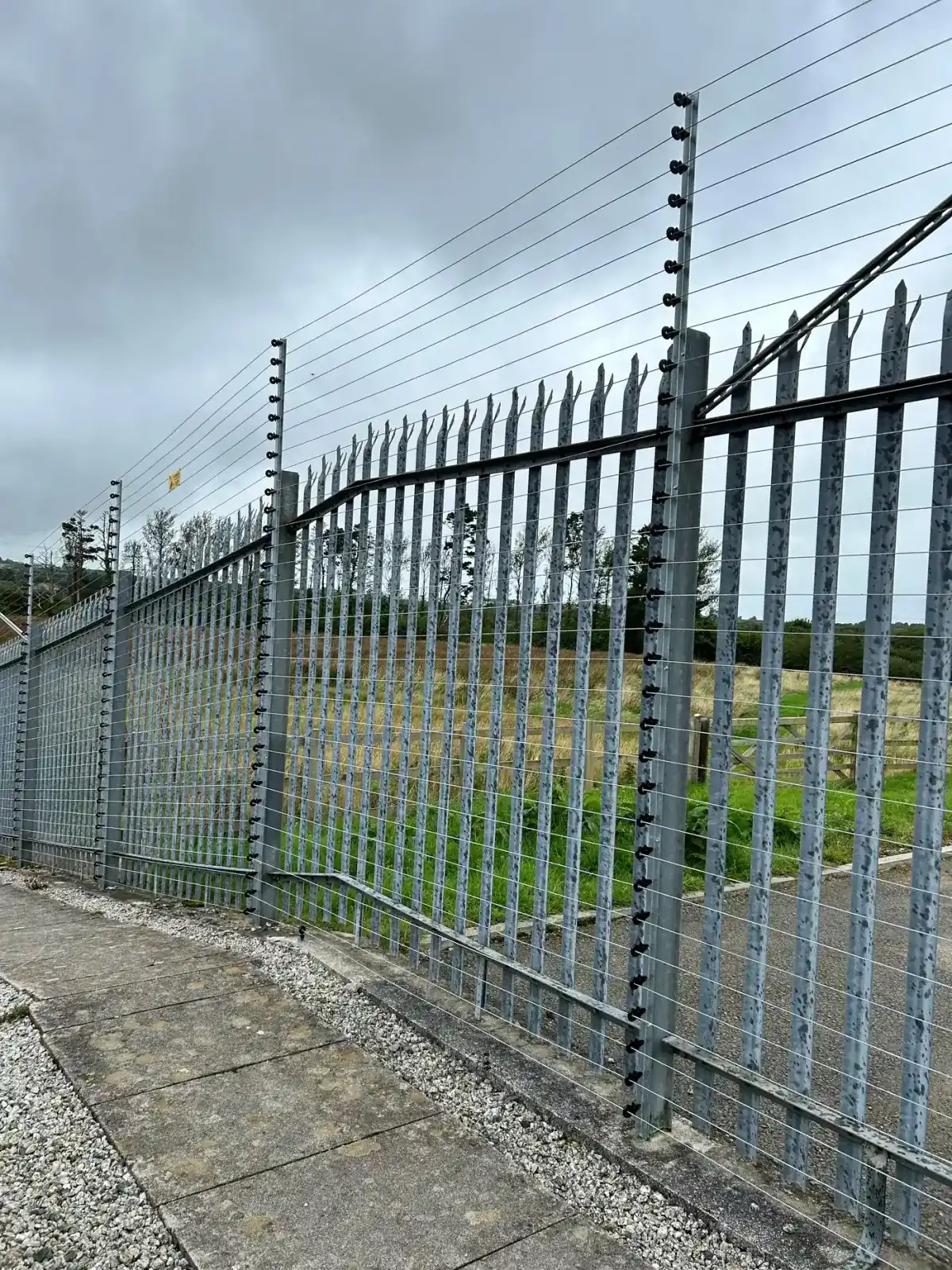
A robust, anti-climb fence, with Electro-Fence™ where the risk justifies an active deterrent. A non-lethal pulsed electric fence stops the casual climber and detects the determined one, raising a zone-specific alarm the moment a wire is cut, climbed or shorted.
Detect on the fence
Flexiguard™ microphonic sensor cable on the fence fabric detects cutting, climbing and lifting along the whole run, in zones of up to 300 m, so operators know which section is under attack. Automatic Environmental Control rejects wind, rain and vibration, which matters next to a runway.
Detect in the open
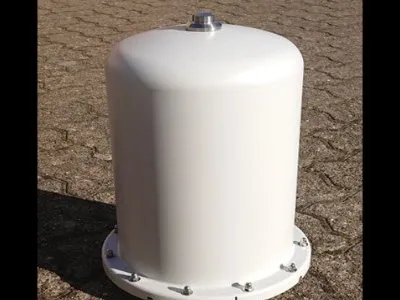
Omni Guard Radar covers airside open ground up to 200 m from each unit, 360 degrees, tracking people and vehicles and steering a PTZ camera onto the target before they reach the fence. Microguard™ microwave barriers and beams close gates, service roads and approaches where there is no fence to sense.
Verify and respond
Every alarm lands in one place, Multisys® or the airport’s existing security platform, on a site map with the camera view attached, so the response is to a confirmed event at a known location.
Radar for restricted areas inside the airport
The outer fence is only part of the job. Inside it, an airport has dozens of smaller areas with their own access rules: fuel farms, cargo and baggage compounds, aircraft maintenance areas, navigation aid and ILS sites, air traffic control equipment compounds, substations and the critical parts of security restricted areas. Many are open ground with no fence to mount a sensor on. Most of the people moving around them are authorised, so a system has to pick out the one who is not.
A single Omni Guard radar covers a circle 400 m across and scans the full 360 degrees every second, which suits these areas well.
- Zones drawn around what matters. Programmable detection zones cover the compound or approach that needs protecting and leave live service roads and stands outside, so routine airside traffic does not raise alarms.
- Day, night and all weather. Radar works in darkness, rain and fog, where cameras alone struggle. The unit is IP66 rated and built for winds of up to 200 km/h on exposed airside ground.
- Fewer nuisance alarms. Omni Guard filters out small animals, a constant on open airside grass.
- Every alarm verified. On detection it slews up to four PTZ cameras onto the target over ONVIF Profile S, tracks up to four people or vehicles per sector, shows them on a map in real time and sends the alarm to the VMS or control room.
- Simple to add. One Power over Ethernet cable (10 W), browser-based software with no licences and a licence-exempt 24 GHz band. GPS synchronises multiple radars where one is not enough.
On a long outer perimeter, Omni Guard works alongside Flexiguard™ and Electro-Fence™ rather than replacing them. Inside the fence, it is often the simplest way to put a detection boundary around an area that has none.
Omni Guard was also trialled on open water from HQS Wellington on the Thames. Read the trial.
Which standards apply, and to what
Airport security lists are long, and most of the documents on them apply to the airport, not to a piece of equipment. It helps to separate the three groups.
Frameworks the airport must meet
ICAO Annex 17 is the international baseline. The UK National Aviation Security Programme sits under the Aviation Security Act 1982, directed by the Department for Transport with the CAA as compliance regulator, and includes retained Regulation (EC) 300/2008 and Implementing Regulation 2015/1998, chapter 1, which covers airport boundaries, security restricted areas, surveillance and patrols. EU airports work to the same two regulations; US airports to TSA 49 CFR Part 1542 and the TSA guidelines for airport planning, design and construction. These set out what the perimeter must achieve. They do not say how. APS works with integrators to supply systems that help airports meet them; they are not standards a product can be certified against.
Standards APS equipment holds
Omni Guard Radar meets EN 300 440 and EN 301 489 for radio and electromagnetic compatibility, and operates in the 24.05 to 24.25 GHz band at 100 mW EIRP, which is licence-exempt under Ofcom’s short range device rules. Electro-Fence™ is installed to BS 1722-17 with energisers meeting BS EN IEC 60335-2-76. Electro-Fence™ and Flexiguard™ are listed in the NPSA Catalogue of Security Equipment, the UK product-assurance route for perimeter detection, which airport buyers increasingly ask for because airports are critical national infrastructure.
Siting and network rules that apply at installation
CAP 168 and ICAO Annex 14 set height limits and frangibility requirements for structures near runways and taxiways; they apply to the mast a radar sits on, not the radar. CAP 738 aerodrome safeguarding applies because a radar transmits, so the airport checks that new emitting equipment will not affect its own systems; Omni Guard’s 24 GHz band is well away from airport surveillance and surface movement radar, and siting still goes through the safeguarding process. The UK NIS Regulations and CAA cyber oversight under CAP 1753 apply to the airport network, which matters because Omni Guard and Multisys® sit on it and the airport’s cyber team will want to review them.
Proven In The Field
Case study: Hyderabad International Airport, 2008
In 2008 Advanced Perimeter Systems was commissioned to protect Rajiv Gandhi International Airport, Hyderabad, a major hub with commercial and strategic importance. The airport's 17.4 km perimeter wall needed a fail-safe system against threats ranging from theft and vandalism to terrorism.
Electro-Fence™ was installed along the full perimeter, mounted on top of the concrete wall, and connected to Multisys® over the airport's own network so every zone was monitored from the control room in real time. The project was delivered with Godrej Security Solutions, part of the Godrej Group, combining APS equipment with local installation and support. It gave the airport a visible deterrent on the wall, centralised oversight of every zone and low-maintenance operation across one of the longest electrified perimeters in civil aviation at the time.
Perimeter wall protected
Project delivered
Multisys® on the airport network
Specifying airport perimeter detection: questions to ask
- What is the probability of detection for a climb, a cut and a lift, and the nuisance alarm rate in wind above 40 mph?
- How long is a detection zone, and can zones be aligned to the airport’s response sectors?
- Does the radar interfere with airport radar, and has siting been through the aerodrome safeguarding process?
- How are alarms presented to the control room, and can they drive existing cameras?
- What happens on power failure, and can remote sections run on solar?
- Has the equipment been independently tested, and where is it manufactured and supported?
FAQ
Airport perimeter security questions, answered.
How is an airport perimeter typically secured?
With a layered system: a physical fence, fence-mounted detection, open-ground radar or microwave coverage at gates and approaches, and a central platform that verifies alarms with cameras.
Can an electric fence be used at an airport?
Yes. Non-lethal pulsed electric fencing is used on airport perimeters worldwide, including on top of walls, and raises an alarm when touched, cut or climbed. In the UK it is installed to BS 1722-17 with energisers meeting BS EN IEC 60335-2-76.
How do you stop false alarms from aircraft noise and wind?
Flexiguard’s Automatic Environmental Control filters steady-state vibration from wind and nearby activity. Omni Guard Radar filters out small animals, and its detection zones are drawn so that routine airside movement does not trigger alarms.
Can radar protect restricted areas inside an airport?
Yes. A 360 degree radar such as Omni Guard covers a 400 m diameter area from one unit, with programmable zones around fuel farms, cargo compounds or equipment sites, and points a camera at anyone who enters.
Does Omni Guard Radar interfere with airport radar?
Omni Guard transmits in the licence-exempt 24.05 to 24.25 GHz band at 100 mW EIRP and meets EN 300 440 and EN 301 489, well away from the bands used by airport surveillance and surface movement radar. Siting still goes through the airport’s safeguarding process under CAP 738.
Does APS have airport experience?
Yes. In 2008 APS secured the 17.4 km perimeter of Hyderabad International Airport with Electro-Fence and Multisys, delivered with Godrej Security Solutions.
Talk To The Manufacturer
Securing an airfield or airport boundary?
Tell us about the perimeter, the restricted areas inside it and how alarms need to reach your control room. An APS engineer will come back with a layered design, the standards that apply to each part of it, and an honest view of where you do not need to spend.
Related reading: what is a PIDS?
Request an airport perimeter assessment
No obligation. Airside constraints, standards and integration questions welcome.