Knowledge · Perimeter Security
What is a perimeter intrusion detection system (PIDS)?
How a PIDS works, the main types compared, how a fence sensor tells a climber from a gale, and how to choose one, written by the UK manufacturer of Flexiguard™ and Electro-Fence™.
The definition
A perimeter intrusion detection system, PIDS for short, is a system of sensors and processing that detects a person crossing or attacking the boundary of a protected site and raises an alarm that says where. It turns a fence, wall or strip of open ground from a passive obstacle into a monitored line, so that security teams learn about an intrusion at the perimeter rather than when someone appears inside a building.
A PIDS does not stop anyone by itself. Its job is detection and location. Deterrence comes from the physical barrier or an electrified fence, delay from the barrier's construction, and response from the people and cameras the alarm triggers. The best perimeters design all four together.
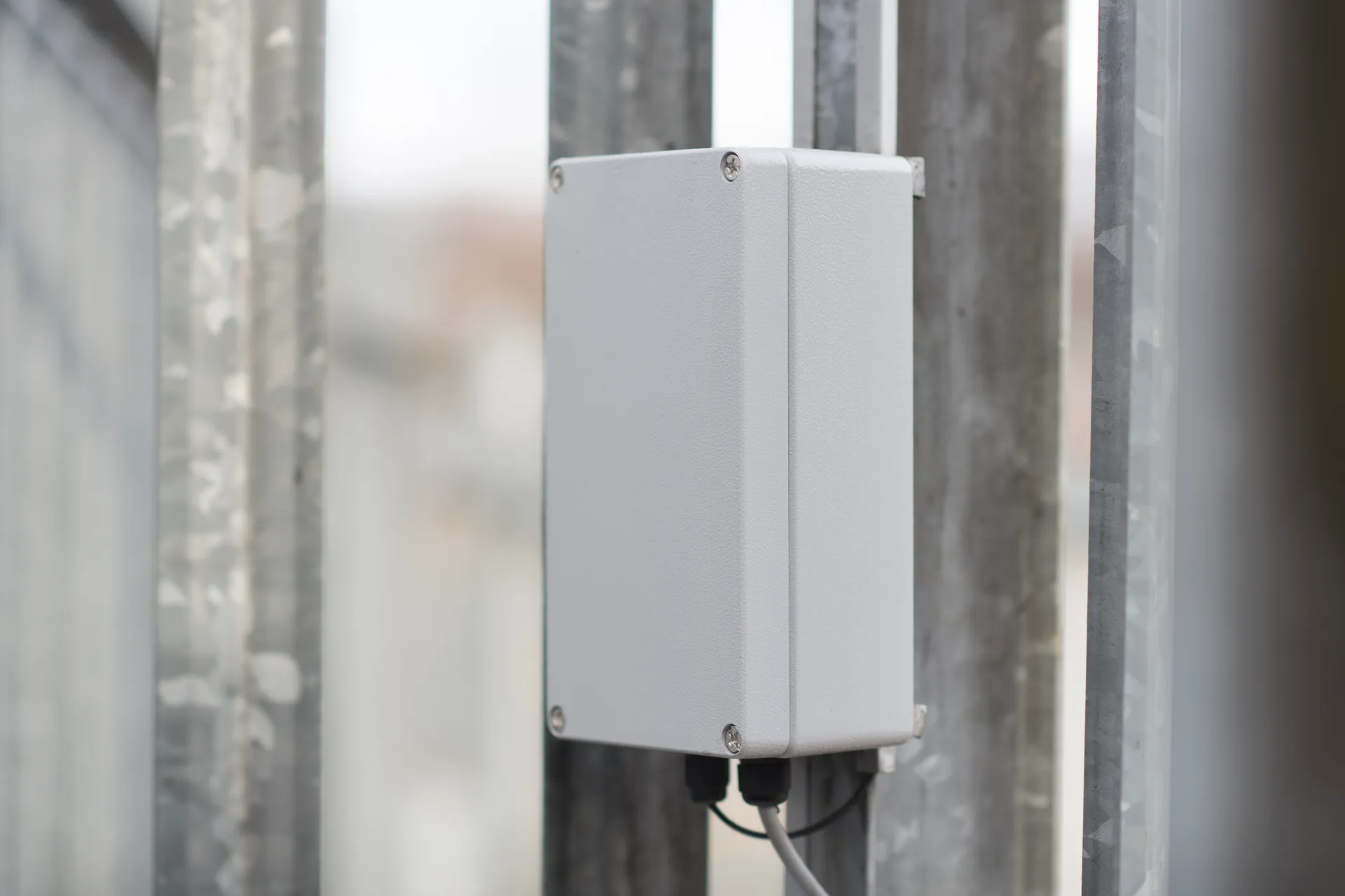
Flexiguard™, an NPSA-listed fence-mounted PIDS, manufactured in the UK.
How a PIDS works
Every PIDS has the same three parts: a sensor that reacts to a physical event, a processor that decides whether the event is an intrusion or the environment, and an output that tells someone. The differences between technologies are about which event they sense and how well they tell an intruder from the weather.
Take Flexiguard™ as an example. The sensor is a microphonic cable attached to the fence fabric. Cutting, climbing or lifting the fence makes the fabric vibrate, the cable converts that vibration into an electrical signal, and the analyser compares it against the signature of wind, rain and traffic. Only a pattern consistent with attack produces an alarm, assigned to a zone of up to 300 m, delivered as a relay contact or over RS485 to the control room.
How Flexiguard™ tells a climber from a gale
Every attack on a fence has its own signature. Cutting or climbing the fabric produces vibration at a different frequency from a sheep scratching itself against the fence line, rain on the mesh, wind loading the panels or a loose strand of barbed wire blowing against the posts. Flexiguard™ listens for the frequencies that match an attack and ignores the rest. On site, the engineer tunes each zone into its environment using the analyser's sensitivity and gain settings, so the system alarms on a cut or climb but stays quiet for livestock, rain, wind and moving wire on that particular fence.
The main types of PIDS
| Type | What it senses | Best for | Watch out for |
|---|---|---|---|
| Fence-mounted (microphonic or vibration cable) | Vibration of the fence fabric: cut, climb, lift | Any site with an existing fence; long boundaries; zone-level location | Needs a sound fence and proper tuning; poor fences give nuisance alarms |
| Electrified fence (NLEF) | Electrical change on the wires: cut, short, climb, tamper | High-security and CNI sites that want deterrence and detection in one layer | Governed by BS 1722-17 and IEC 60335-2-76; not every site permits electrification |
| Microwave barrier and beam | A person or vehicle breaking an invisible field between two heads | Gates, approaches, sterile zones, open ground up to 200 m | Needs clear line of sight; vegetation and standing water affect it |
| Perimeter radar | Movement across open ground, tracked and located | Large, open or temporary sites; cueing cameras; early warning before the fence | Clutter from trees and roads must be zoned out; higher cost per unit |
| Buried cable and ground sensors | Pressure or field disturbance underground | Covert detection where nothing may be visible | Not an APS product; included for completeness |
| Fibre optic fence sensing | Light disturbance along a fibre on the fence | Very long perimeters, typically 5 km and more, that need pinpoint location | Not an APS product; higher cost and harder to repair |
Microphonic cable or fibre optic?
Fibre optic sensing is the right choice for a narrow set of sites: very long perimeters, typically 5 km and more, that need pinpoint location along the fence, and locations where lightning immunity is a priority. For everything else, microphonic cable is the stronger choice. It is the more proven technology, it is considerably more cost-effective to buy and install, and it is far easier to repair: a damaged section of cable is a straightforward fix rather than a specialist fibre splice. Zone-level location, with each zone up to 300 m and verified by cameras, gives the control room everything it needs to direct a response on the great majority of sites.
What about taut wire?
Taut wire systems use rows of horizontal wires strung under carefully set tension between anchor posts and sensor posts. Pushing, spreading, climbing or cutting a wire changes its tension and trips the sensor. Because it responds to tension rather than vibration, taut wire rejects wind and small animals well, which is why it is often found on high-security government and defence boundaries.
The trade-off is cost and practicality. Taut wire is a purpose-built fence system rather than something added to the fence a site already has: it needs its own wires, dedicated sensor and anchor posts and disciplined installation, and the wires need periodic re-tensioning to keep it performing. Published guidance rates its equipment and installation costs as high and its maintenance as medium, against low on all three for fence-mounted cable. Sectors typically run to around 100 m. Microphonic cable fits directly to an existing chain link, weldmesh or palisade fence or wall, covers zones of up to 300 m, and is tuned on site to ignore wind, rain and livestock. For most sites that delivers the detection a specifier needs at a fraction of the cost and disruption of building a taut wire fence.
How to choose a PIDS
- Start with the threat and the response. A system that detects in seconds is wasted if the response takes forty minutes. Match detection to how fast someone can get there.
- Measure the perimeter honestly. Length, fence type and condition, gates, gradients, vegetation, nearby roads and railways all change the right answer.
- Ask for performance evidence. Probability of detection for defined attacks and nuisance alarm rate per zone per day. In the UK, an NPSA assessment is the evidence that carries weight; CNI specifications commonly allow no more than five unwanted alarms per kilometre per day.
- Check assurance. NPSA assurance (formerly CPNI) and a Catalogue of Security Equipment listing are the benchmark for government and CNI. Flexiguard™ and Electro-Fence™ hold it.
- Plan the integration. Dry relay contacts work with any platform. RS485 into Multisys® gives a site map, event history and camera links. Decide where alarms will land before choosing sensors.
- Think about power and comms. A half-watt analyser can run on solar with wireless alarms, which changes what is possible on remote boundaries.
Where PIDS are used
Utilities and substations, data centres, airports and ports, defence and government estates, prisons, solar farms, logistics depots and warehouses, and increasingly commercial yards that have suffered repeat theft. APS systems are installed on six continents, including 14.2 km of Flexiguard™ around the archaeological sites at the Pyramids of Egypt.
FAQ
PIDS questions, answered.
What does PIDS stand for?
Perimeter intrusion detection system. The same technology is sometimes called a perimeter intruder detection system or a fence alarm system.
What is the difference between a PIDS and an electric fence?
A PIDS detects; an electric security fence deters and detects. Many high-security sites use both.
How does a fence sensor tell an intruder from the wind?
A cut or climb vibrates the fence at a different frequency from wind, rain, livestock or loose wire. The analyser listens for the attack frequencies, and an engineer sets the sensitivity and gain for each zone on site so the system ignores the environment.
Is fibre optic better than microphonic cable?
Only on very long perimeters, typically 5 km and more, that need pinpoint location or lightning immunity. For most sites microphonic cable is more proven, more cost-effective and much easier to repair.
Can a PIDS be fitted to an existing fence?
Yes. Fence-mounted sensor cable attaches to chain link, weldmesh and palisade fencing and to walls.
What is a good false alarm rate?
UK critical infrastructure specifications commonly allow no more than five unwanted alarms per kilometre per day. A well tuned fence-mounted system on a sound fence should sit comfortably inside that.
Talk To The Manufacturer
Choosing detection for a perimeter?
Tell us about the fence, the site and the threat, and an APS engineer will tell you which type of detection fits, which does not, and why.
Related reading: the complete guide to non-lethal electric fencing and choosing the right PIDS for your perimeter.
Ask a detection engineer
No obligation. Fence condition, zoning and integration questions welcome.